When conducting audits of automotive quality systems and requesting evidence of 2nd-party auditor competency, I often encounter a recurring, somewhat baffling scene.
A manager confidently presents a certificate from a multi-day "IATF 16949 Internal Auditor Training Course" and argues: "Our auditor completed the internal training and has conducted several in-house audits. They know the audit techniques, so aren't they naturally qualified to perform 2nd-party audits at our suppliers?"
This is a dangerous misconception. It represents a fundamental misunderstanding of supply chain risk management in the automotive industry. Even many external training curricula for 2nd-party auditors focus heavily on interpreting IATF clauses or ISO 19011 techniques, while completely ignoring the actual manufacturing processes of the supplier.
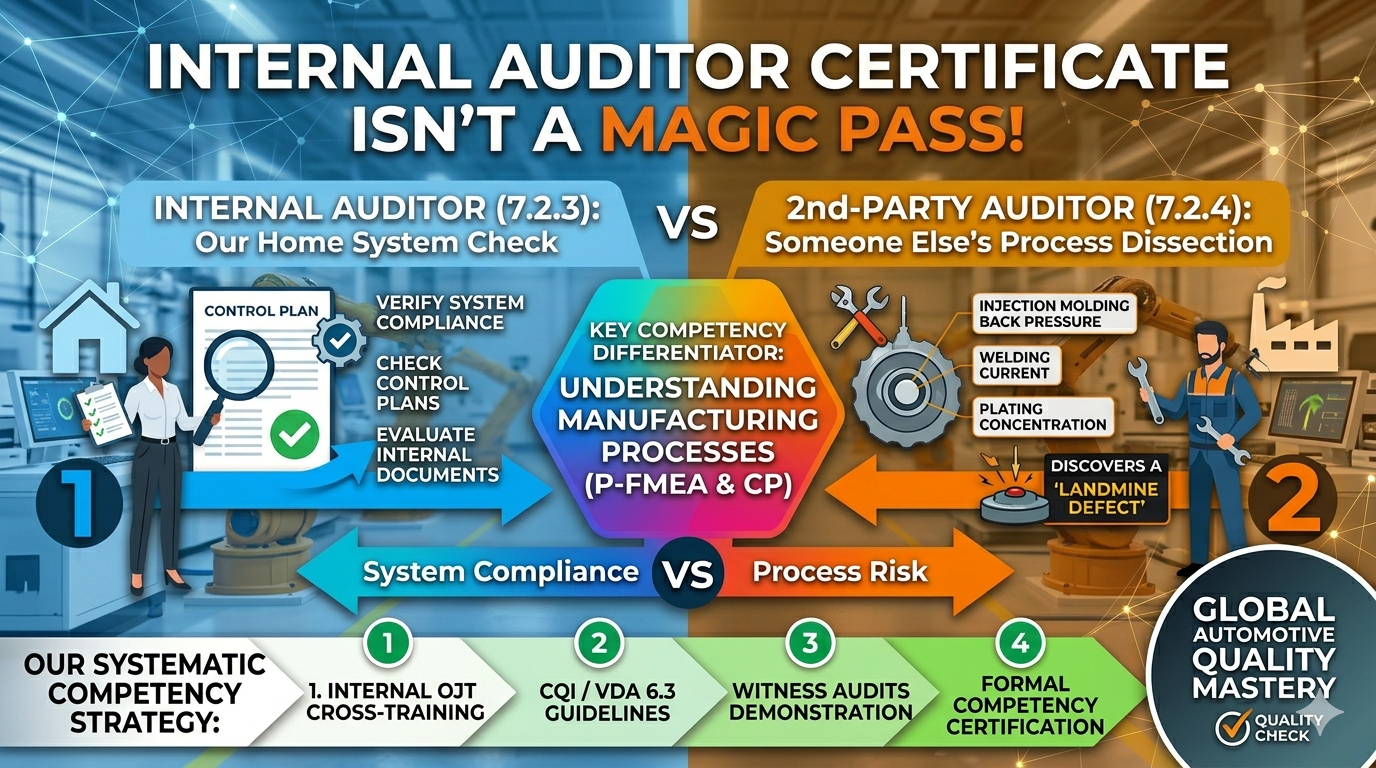
Today, let’s dissect the "engineering truth" behind the competency differences between Internal Auditors (Clause 7.2.3) and 2nd-Party Auditors (Clause 7.2.4) as defined by IATF 16949.
1. The Essence of Requirements: Checking the System (7.2.3) vs. Piercing the Process (7.2.4)
The IATF 16949 standard defines the competency requirements for internal and 2nd-party auditors separately. The critical differentiator is the "understanding of the relevant manufacturing processes to be audited, including P-FMEA and Control Plans."
· Internal Auditor (7.2.3): Verifying Compliance in "Our Home" Their primary role is to ensure our own Quality Management System follows standards. If they understand the Automotive Process Approach, Core Tools (FMEA, SPC, MSA, etc.), and can verify if our shop floor follows our own Control Plans, their competency is generally recognized.
· 2nd-Party Auditor (7.2.4): Dissecting Risks in "Someone Else’s Home" The requirements for 2nd-party auditors include everything expected of an internal auditor plus an explicit requirement for competency in understanding the specific manufacturing processes being audited. This isn't just about reviewing paperwork; it is Process Engineering Competency. It means being able to intuitively analyze how unfamiliar parameters—like back pressure in injection molding, current values in welding, or chemical concentrations in plating—affect the final product quality (Y).
2. The Paradox: An Auditor Without Process Knowledge is Just an "Administrator"
The irony lies in many external training programs labeled as "2nd-Party Auditor Courses."
· The Half-Baked Curriculum: Most courses focus on how to audit a supplier's "System" (manuals and procedures). They fail to teach the manufacturing process knowledge that actually dictates quality—such as why moisture control is vital in plastic molding or how the viscosity of stamping oil affects a press process.
· The Resulting Crisis: What happens when an auditor with only internal training goes to a supplier? They ignore dangerous equipment settings or poor mold management and instead spend the whole day in an office making superficial administrative comments like "This document isn't updated" or "A signature is missing." A month later, that same supplier suffers a massive defect that shuts down your assembly line.
3. Practical Solutions: How to Demonstrate "Process Evaluation" Competency
Since external institutions rarely teach this, how should an organization secure and demonstrate this competency? You must move beyond certificates and activate a field-centered cultivation system.
· Utilize Internal Cross-Training: Don't rely solely on external courses. Send your 2nd-party auditor (SQE) candidates to work under your own in-house veterans in pressing, molding, or welding for a few days of OJT. Let them see firsthand which defects (Y) occur when key process parameters (X) fluctuate.
· Integrate CQI and VDA 6.3 Guidelines: Use the AIAG CQI series (Special Process Assessments) or the German VDA 6.3 (Process Audit) questionnaires as primary textbooks for training.
· Demonstration via Witness Audits: Competency should not be granted immediately after training. Candidates should perform a "witness audit" alongside a lead auditor or process expert at a supplier site. The ability to independently identify manufacturing risks during this practical test—documented in a report—serves as the perfect "evidence of competency" required by IATF 16949.
Closing: A Supplier’s Heart Beats in the "Process," Not the Paperwork
To all executives and system leaders: Stop the administrative convenience of substituting internal auditor certificates for 2nd-party qualifications. Internal auditing is like cleaning your own well-organized living room; 2nd-party auditing is a high-stakes engineering mission to navigate an unfamiliar, often "mined" territory.
An auditor without the knowledge to dissect a manufacturing process will never find the "landmines" of defects.
Face the harsh reality of why IATF 16949 sets a stricter bar for 2nd-party auditors. When you equip your auditors with "eyes that read the process" rather than just "eyes that read documents," your supply chain will finally achieve a defense that is unshakable.
[Source Context]
· Demographics: The user is an Executive Director at K-PLANT with 30+ years of experience in automotive quality management.
· Interests: Expert in IATF 16949, VDA 6.3, and supply chain oversight for Hyundai/KIA partners.
· Recent Projects: Launched a professional blog in May 2026 to share quality management expertise.
'품질관리' 카테고리의 다른 글
| 품질경영-APQP 3판의 핵심, REMP '변명' 아닌 '평가' (3) | 2026.05.13 |
|---|---|
| The Real Reason Why 2nd-Party/Supplier Auditor Qualifications Must Be "Relentless" (0) | 2026.05.13 |
| 품질경영-Kg 및 Kgf의 차이 (0) | 2026.05.12 |
| The Core of AIAG Control Plan 1st Edition: What is PTC (Pass-Through Characteristic)? (0) | 2026.05.12 |
| What is CT, TT, LT, and ST (0) | 2026.05.12 |

